
Your Library funding:
Thank you, Lucas County taxpayers!
With the passage of Issue 8, the Library will bring back hours that were reduced (Main, King Road, Holland, Waterville, and Mobile) due to state budget cuts of nearly $2 million, so everyone can enjoy great Library services. This means:
- Restoring all hours, including Saturdays, to King Road and Waterville on January 2, 2027. (Holland hours will be restored once it reopens.)
- Adding Sunday hours to Sylvania, Heatherdowns, and Oregon Branch on January 2, 2027.
- Restoring Main and Mobile hours by early summer 2027.
The levy will also help the Library protect and continue offering so many free services to the community:
- Printed books
- Digital materials (audiobooks, ebooks, streaming movies, and music)
- Programs for everyone!
- Ready to Read early literacy
- After-school programs
- Adult education and hobbies
- Book clubs
- Visiting authors and concerts
- Community connections
- Free meeting rooms
- Partner programs from health care to job help and veteran services
With 60% of Library operational funding coming from local taxpayer dollars, your support makes all of this work possible – thank you!
As published in the September 20, 2026 edition of the Toledo Blade:
Read, get your return, repeat.
Jason Kucsma, Chief Executive Officer/Fiscal Officer
Toledo Lucas County Public Library
Word count: 544
“What can the public library do for me?” It’s a question that I love to answer.
I am always eager to share the many anecdotes I hear every day about how library programs, services, and staff positively impact someone’s life. But beyond these narratives, the Toledo Lucas County Public Library has an equally impactful quantitative story to tell.
Last year, the Toledo Library saw over two million visits and had five million titles checked out. We also welcomed more than 115,000 guests who joined us at one of our 4,000 programs. All in all, almost 70 percent of Lucas County residents hold a library card, which speaks volumes to our place in the hearts and minds of community members.
For the tens of thousands of Toledo Library users, there is a deep understanding of all the wonderful things the public library offers. However, these statistics also come with a real economic impact on Lucas County taxpayers.
In a recent study conducted by the Center for Regional Development at Bowling Green State University, researchers found that the Toledo Lucas County Public Library returns $6.73 for every $1 invested by taxpayers. The study involved an intensive review and analysis of three of the library’s key strategic priorities – helping children learn to read, helping adults expand their horizons, and serving as the go-to community connection and hub.
Researchers took into account the money saved through the library’s collective buying power for services such as storytimes, author events, small-business assistance, and on-site community partner services. They also evaluated other library-powered work, like our Ready to Read early childhood literacy team, reading challenges, technology access and assistance, meeting room use, and library outreach services.
“What can the public library do for me?” You can join your neighbors at one of our many amazing programs. You can check out books, movies, and music. You can make reading central for the children in your life. You can get help with your small business dreams. You can reap the substantial benefits of your tax investment. But, whether or not you hold a library card today, the amazing thing about the Toledo Library is that we offer a real, year-round economic return for all Lucas County residents.
For example, at our new Washington Branch Library campus, which includes an operations center for greater library efficiency and our Friends of the Library bookstore, we’ve returned nearly $4.5 million in wages and benefits to area tradespeople. From the outset of this project, the library has been committed to promoting participation and expanding opportunities for both working individuals and businesses, with an emphasis on Minorities, Women, Disadvantaged, and Veteran-owned businesses. Not only does the library return dollars through our programs and services, but also through our local projects.
As a tax-funded institution, the Toledo Lucas County Library has an incredible responsibility to manage our money well and, above all, to fulfill the wants and needs of our taxpayers for library services. We strive to offer the best programs and materials we can to Lucas County residents, and we work hard to ensure your money has maximum impact and return.
“What can the public library do for me?” We hope to see you in the near future, so that you can discover the answer soon.
Jason Kucsma
Chief Executive Officer/Fiscal Officer
Toledo Lucas County Public Library
House Bill 309: Regards budget commissions, property tax, and certain funds
Primary Sponsor: Representative David Thomas (R, Jefferson)
What does it do?
Updates County Budget Commission (CBC) procedures to enhance oversight and levy adjustments.
Authorizes CBCs to reduce property taxes to avoid unnecessary or excessive collections, except where law requires approval without modification. Unnecessary Collections: Those beyond the reasonably anticipated financial needs of the taxing authority. Excessive Collections: Those in the amount or at a rate that exceeds what is required to provide services at a level that is consistent with the taxing authority’s statutory obligations
The bill includes a “safe harbor” provision that protects school districts from losing state education funds if they levy less than 20-mills for operating expenses due to voluntarily forgoing additional revenue.
How you’re impacted
If a CBC wants to reduce a levy to avoid unnecessary or excessive collections, they must allow the taxing authority (or any relevant party) to present at a public hearing whether and to what extent the levy should be reduced.
Limits the requirements that CBCs approve all voted property tax levies without modification to only the first year of a levy’s collection.
This bill broadens the CBC’s authority.
Statewide library funding
When Ohio legislators proposed a reduction to the Public Library Fund in spring 2025, taxpayers from across the state reached out to protest the change. In Lucas County, over 6,000 emails were sent, and 500 handwritten letters were delivered to legislators. Despite the outpouring of support, state legislators passed a biennium budget that reduces funding for TLCPL by $1.6 million over the next two years, on top of a current $2.8 million deficit due to continued system-wide rising costs.
This, combined with the current climate of reduced investment in public institutions, requires the Toledo Lucas County Public Library to make operational changes to sustain our organization in the face of decreased revenue.
What the Library has done in 2025
The Library has been systematically reducing expenses wherever possible for programming, training, maintenance, and overall operations. Additionally, we have been battling the same inflation that households experience with increased expenses for utilities, supplies, software, maintenance, etc. As legislators started advocating for decreased funding, we froze administrative pay, offered retirement options, and further reduced operational expenses by nearly $900,000.
Our goal has been to make as many reductions as possible that avoid impacting the customer experience, but this is no longer possible with the new state budget reductions.
Next steps
Toledo Heights and Heatherdowns consolidation:
The biennium budget leaves us no choice but to reduce expenses with painful cuts to our services. To make decisions that still provide the community with as many service options as possible, we looked at visitor numbers, materials circulation, and program attendance at similarly sized locations across the system. These three metrics are the best point of comparison to determine if a location is operating at its fullest potential.
Toledo Heights Branch, despite a loyal customer base, has consistently lagged behind other neighborhood branches across these three measurements. The state’s historic funding model allowed us to continue to serve this neighborhood while always looking for ways to increase usage.
Additionally, bringing this branch up to date, including current accessibility standards, could approach $6 million. These would just be structural upgrades that would not expand space or services.
Just down the road (three miles away), we are also looking at a new location for the Heatherdowns Branch. We are unable to expand the size of this busy location on our current property. So, we have decided that a new, consolidated branch is the best option to maximize our resources and reach.
The new branch will be about 1.5 miles from each current branch, and in a high-visibility location, which we know increases customer access. For example, Heatherdowns currently sees 105,092 customer visits per year. Sanger is a similarly sized location, but on a busy street, and has 143,959 visits per year. A new consolidated location in a high-visibility area for Heatherdowns and Toledo Heights will allow us to reach more customers while only paying to operate one building.
The last day the Toledo Heights building will be open is (W) Dec. 31, 2025. Heatherdowns will remain in operation until the new centralized location that will serve both the Toledo Heights and Heatherdowns neighborhoods opens in 2028.
We will work with the community as we search for new occupants and uses for each building.
We will also be hosting listening sessions for the consolidation, with dates to be announced.
Reduced service hours
While the consolidation of Toledo Heights and Heatherdowns Branches will reduce the number of buildings we maintain and allow us to reassign staff, further reductions are still needed to meet our declining revenue.
When looking at our locations map, we worked to limit the hours reductions to branches that served customers who would most likely be able to go to other locations if needed. The reduced hours are also at locations where we have staff and hours that can be adjusted.
Beginning Jan. 4, 2026, the following locations will
move to one shift:
Main Library
M – Tu. | 9 a.m. – 5:30 p.m.
W – Th. | noon – 8:30 p.m.
F – Sa. | 9 a.m. – 5:30 p.m.
Su | Closed
Holland, King, Waterville
M – Tu | noon – 8:30 p.m.
W – F | 9 a.m. – 5:30 p.m.
Sa. – Su. | Closed
Mobile Services
M – F | 9 a.m. – 5:30 p.m.
All other locations will maintain their hours as listed on our location page.
Building for the Future
We are committed to keeping your Library as strong as possible in this time of reduced funding for the public good. Part of that work will be to responsibly invest the $153 million bond Lucas County voters approved in 2024. These tax dollars are completely restricted and can only be used for the building and construction projects that we asked voters to support.
This community investment will allow us to preserve a strong library presence for Lucas County. We know how much the community loves the Library and will be doing our best to build a sustainable organization in the face of uncertain funding.
More information:
We invite you to contact your state legislators to express your concerns about current and future library funding.
Since February, the Toledo Lucas County Public Library has been advocating to state legislators to maintain Ohio’s public library funding model. Despite your outreach to preserve strong library funding, the new and reduced model is all but finalized and will be enacted on July 1 of this year. However, we have one final opportunity to advocate against a restrictive library policy in the state budget.
Protect your right to read by emailing Governor Mike DeWine—a longstanding champion of public libraries—today. Ask him to veto a provision in Ohio’s budget that would place all books related to sexual orientation and gender out of the view of readers under the age of 18. Here is the exact language as currently written:
“Requires a public library to place material related to sexual orientation or gender identity or expression in a portion of the library that is not primarily open to the view of minors.”
This bill’s language is dangerously vague, overly broad, and ultimately unworkable. It opens the door to unconstitutional censorship and undermines the core mission of libraries—to provide free and open access to information.
Additionally, here at the Toledo Lucas County Public Library, our organization already has a clear and publicly accessible collection development policy, which outlines how any Lucas County/Ohio resident can request a book be reconsidered by library staff.
Why? Because Lucas County citizens know that libraries do not and should not act in parents’ place. It is up to the guardian or parent to decide what their children can and can’t read, as well as how their children can access books with or without them physically present.
This policy included in the budget bill would require each of our 20 library branches plus mobile services, (who welcome hundreds of children into their spaces each day) to construct a physical walled-off area where all books that reference sexual orientation and gender would be placed. Being a tax-funded institution, it will cost the library system millions of your dollars to do this in every branch—if it’s even possible. In some locations, this mandate could require us to make some of our locations adult-only libraries, depriving children and families of a shared public resource. Additionally, it would take years for library staff to comb through our millions of books, searching for mentions of gender or sexual orientation.
The bottom line is this: Libraries are spaces for everyone, where a world of experiences and ideas are there to be explored. Not every book is right for every person, but only you should decide what you and your children get to read. Segregated spaces are not what a library, nor a community, is all about.
Public libraries are truly a marketplace of ideas representing the diversity of thoughts and perspectives that make Lucas County a place we love to call home. Urge Governor DeWine right now to veto this provision!
Governor Mike DeWine
Main Line: 614.466.3555
Governor’s Hotline: 614.644.4357
Message: https://governor.ohio.gov/contact
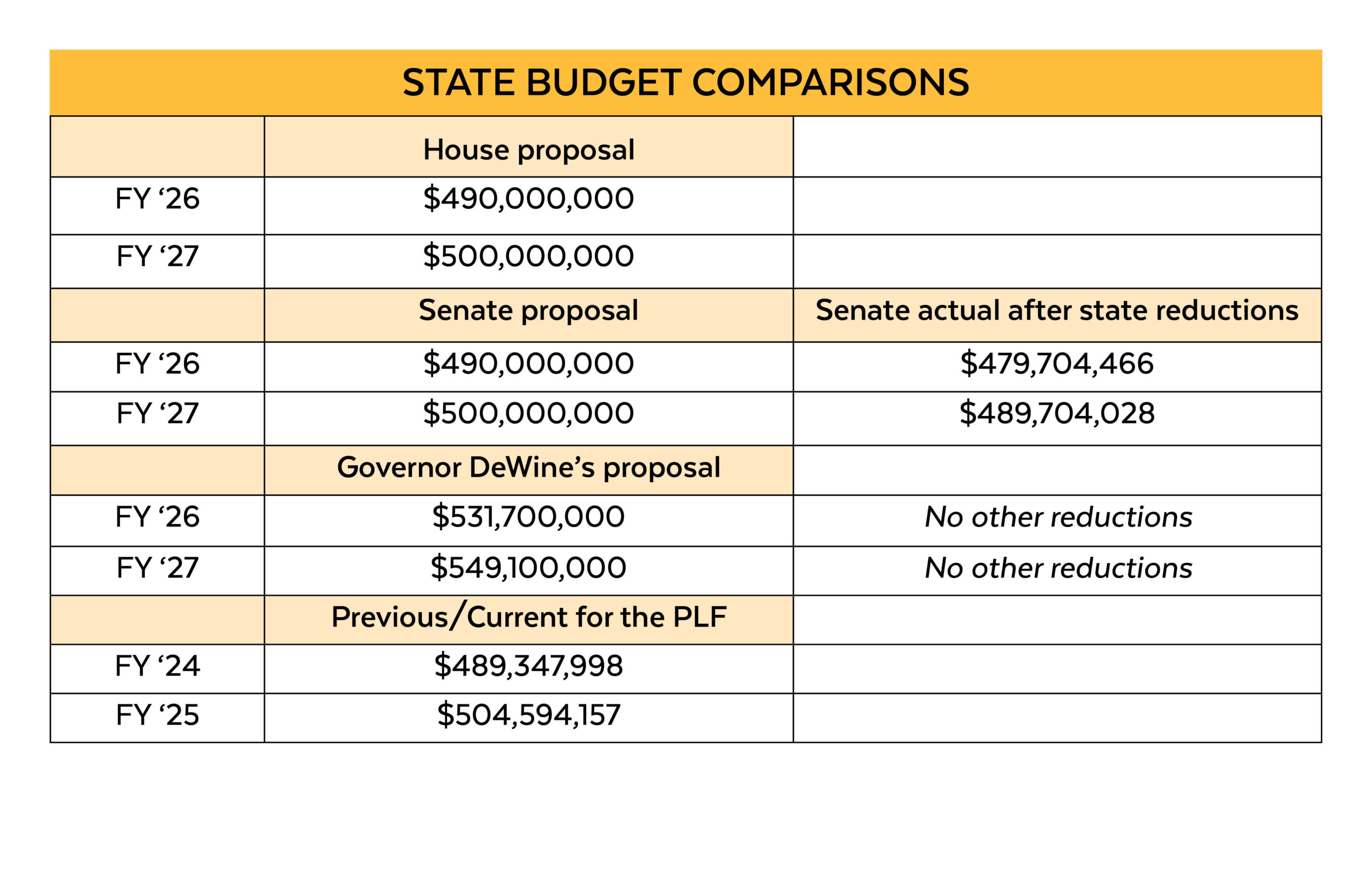
There are still some steps remaining in this budget process. We are continuing to advocate for the reinstatement of the Governor’s Public Library Fund proposal ($531.7 million in fiscal year 2026 and $549.1 million in fiscal year 2027) and the elimination of the additional constraints on public library operations.
Even though the state general operating budget proposal has passed both the Ohio House and Ohio Senate, there is still time to advocate via the budget conference committee—which is composed of leadership from the Senate and House—which happens before the budget gets to the Governor’s desk.
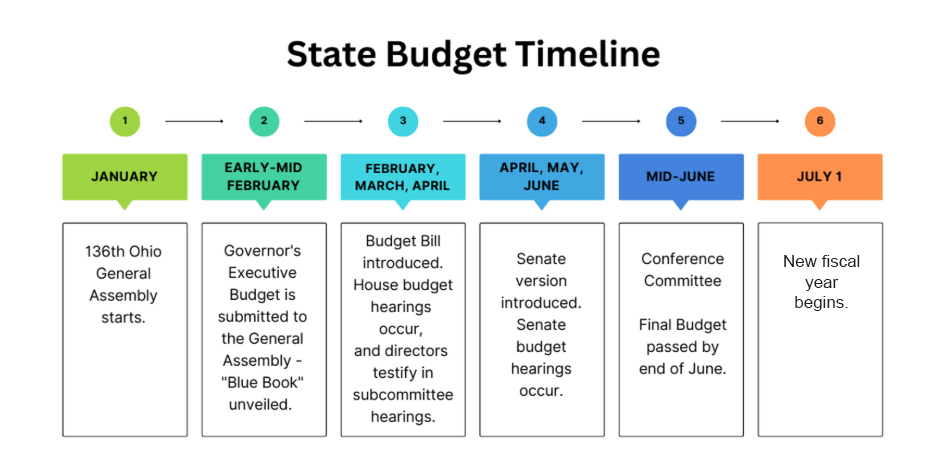
At this stage in the process, direct conversations between legislative leaders and library leaders are likely to yield positive results. However, we wanted to keep you, the taxpayer, apprised of this legislative activity that will affect our future ability to provide the materials, programs, support, technologies, building access, and staff support that you depend on.
If you’re interested, here is where the Legislative Service Commission provides a comparison between the House and Senate bills (mention of the Public Library Fund is on page 732, with other Public Library Fund services reductions on pages 554, 555, and 556).
- In fiscal year 2026, the Senate proposal would deliver $490 million to the Public Library Fund.
- In fiscal year 2027, the Senate proposal would deliver $500 million to the Public Library Fund.
- In addition, the following state agencies and entities would be funded through the Public Library Fund, further reducing state funding for public libraries from the line-item appropriation: State Library of Ohio, Ohioana Library, Regional Library Systems, Ohio Public Library Information Network and the Library for the Blind.
- These expenses include the State Library of Ohio, Ohioana Library, Ohio Public Library Information Network, the Library for the Blind, and Regional Library Systems.
- The House voted to remove the Public Library Fund as it currently stands (1.7% of Ohio’s General Revenue Fund) and move this fund to fiscal year appropriations.
- Appropriations are year-by-year lump sums of money, which are much more vulnerable to future funding cuts.
- In fiscal year 2026, the House’s budget would deliver $490 million to the Public Library Fund.
- In fiscal year 2027, the House’s budget would deliver $500 million to the Public Library Fund.
- In fiscal year 2026, this increase would have led to a projected $531.7 million for the Public Library Fund.
- In fiscal year 2027, this would have led to a projected $549.1 million for the Public Library Fund.
As taxpayers and supporters of your local library, we want to ensure that the residents of Lucas County are informed about recent changes and updates regarding the State Budget of Ohio. Here are some facts on the Public Library Fund:
- Roughly 40% of TLCPL’s total operational budget (materials, staff, building maintenance, programs) is supported by the Public Library Fund of Ohio.
- The Public Library Fund is reauthorized every two years in the state budget.
- The Public Library Fund receives just 1.7% of the Ohio General Revenue Fund and is shared amongst all 251 public library systems across the state.
- 48 of the 251 public library systems in Ohio solely rely on the Public Library Fund for operational funding.
- The state has supported public libraries with funding to deliver services at the local level for nearly a century.
TLCPL and public libraries across the state of Ohio have been advocating for a small percentage increase in the Public Library Fund. Why?
- The Public Library Fund has not been adjusted for inflation in 25 years.
- In 2024, the Public Library Fund saw a $27 million shortfall that forced several libraries, including TLCPL, to make funding cuts that didn’t impact customer experience.
- Usage is growing in Ohio libraries. In 2024, Ohioans visited their local libraries more than 48 million times.
- Right now, the Public Library Fund makes up less than 0.5% of the entire state budget.
- For every $1 invested in public libraries, residents see a $5 return in valued services.